
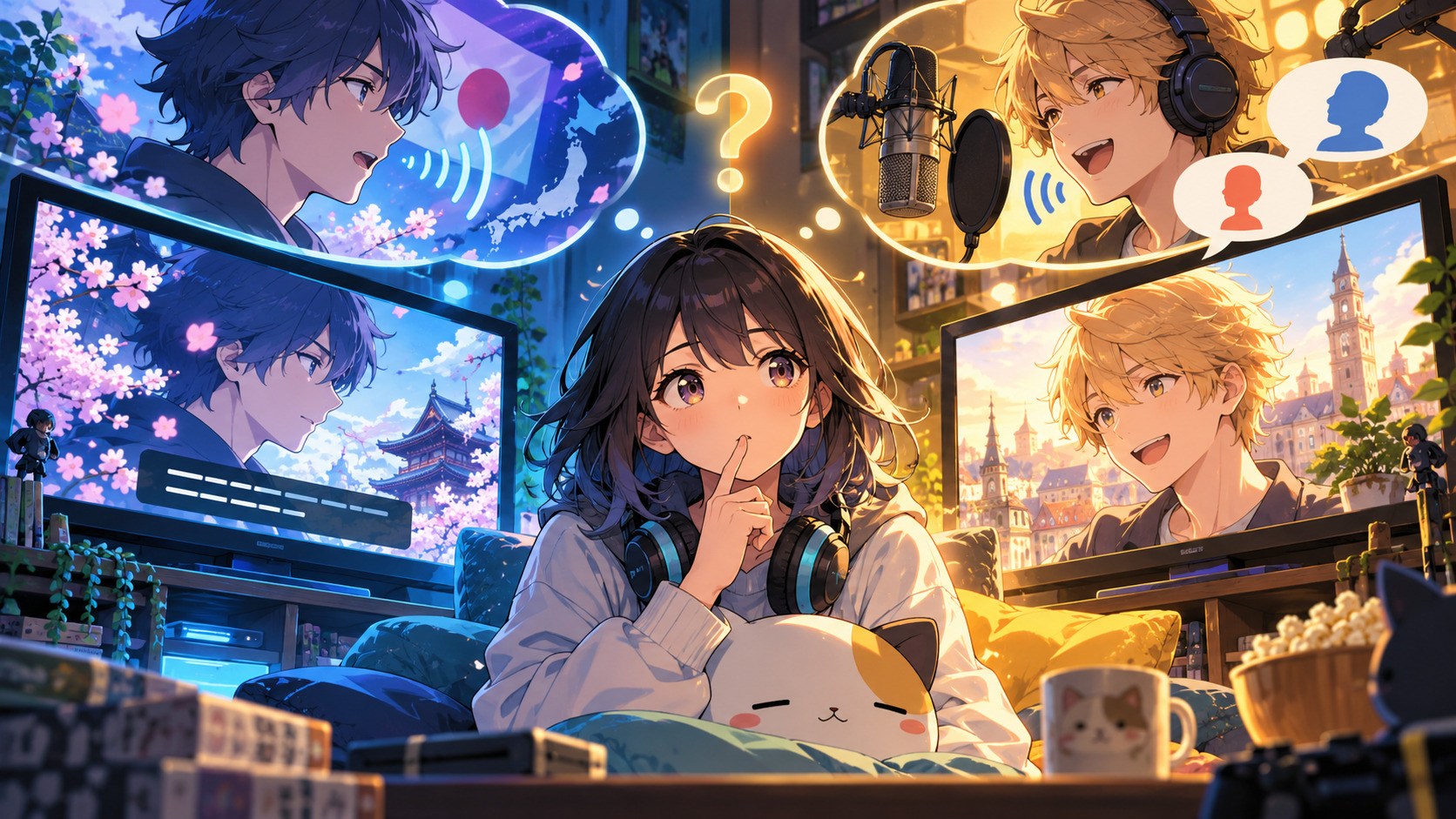
Choose the version that helps you follow the story and enjoy the performances. Subtitles and dubbing offer different ways to do that, and you can change your preference between shows—or between evenings.
For anime originally performed in Japanese, “subbed” usually means Japanese dialogue with translated text on screen. “Dubbed” usually means dialogue performed in another language, such as English. A dub can also be watched with captions when the edition provides them, so the choice is not simply between reading and listening.
What changes between the options?
| Option | What you hear and read | A reason to try it |
|---|---|---|
| Japanese audio with English subtitles | Japanese performances plus translated dialogue in text | You want those performances and are comfortable following subtitles |
| English dub | English dialogue performances | Listening in English helps you follow the story while watching the image |
| Dub with matching captions or SDH | Dubbed dialogue plus text designed for that audio, where available | You want textual support for speech and relevant sounds |
Check the actual audio and text tracks offered for the title, season and device you use. A language being available somewhere does not establish that every edition includes it.
Try subtitles when you want the Japanese performances
Subtitles let you hear the Japanese voice cast while reading the dialogue in a language you understand. That may be the attraction if a particular actor's delivery interests you or if you prefer to keep that cast consistent across the series.
The practical question is whether the reading experience suits the way you watch. In a fast conversation, you may need to divide your attention between text, expressions and action. You can pause or go back, but if you regularly lose the thread, trying a dub is a useful adjustment rather than a failure.
Give the text a fair chance, too. If it is difficult to read, check whether your player offers a different size, contrast or background. Netflix documents subtitle and caption appearance controls, though the available settings depend on the service and device. Use a setting that works for your screen instead of accepting uncomfortable text as an unavoidable part of anime.
Try a dub when listening helps you stay with the scene
A dub gives you another cast's performance of the dialogue. You might prefer it because you can follow spoken English more comfortably, because you want more attention available for the image, or because the people watching with you have different reading preferences.
Listen to the version itself rather than a general claim about dubs. Do the voices make the characters distinct? Can you follow the emotional shifts? Does the dialogue sound comfortable to you in that scene? Those are useful questions whether you choose Japanese or English audio.
Dubbing also involves adaptation and direction. For example, Netflix's creative guidance discusses preserving dialogue intent alongside performance and lip synchronisation. That describes one production framework, not a guarantee that every dub meets the same standard. It does explain why a dub is more than replacing one word with another.
Captions and translated subtitles do different jobs
If you are deaf, hard of hearing or simply want support for the audio, check for captions or SDH—subtitles for the deaf and hard of hearing—rather than assuming any English text track includes everything you need.
Netflix's partner explanation distinguishes translated subtitles from SDH and closed captions. The latter support understanding the audio through dialogue and relevant sound or music information. The terms and formats vary, so inspect the offered track rather than relying on its language name alone.
For an English dub, look for text intended for that English audio. A translated subtitle track may use different phrasing from the dub, making simultaneous reading and listening distracting. Captions should help you follow the version you have chosen, not force you to reconcile two scripts.
Availability needs checking at the episode level when it matters. Netflix notes that SDH may not be available for every season or episode. A series-level badge is a starting clue, not a reason to skip checking the part you plan to watch.
Does one version always translate better?
There is no useful blanket verdict that subtitles are always accurate or dubs always change the story. Evaluate the specific release and the concern you actually have.
An invented example makes the distinction easier to see. Imagine a character reluctantly agreeing to help. “All right, I'll come” and “Fine. I'm coming too” can express a similar decision with different rhythm and attitude. To judge the result, you would need the scene, the intended meaning and the performance—not merely a count of which English words changed.
If a particular translation choice matters to you, look for evidence about that release. Without the relevant language knowledge or a reliable explanation, a difference between two English scripts is a reason to investigate, not proof that one is wrong.
Make a small comparison before committing
If both versions are legally available to you, try the same short, spoiler-free scene in each. Keep the comparison practical:
- Can you comfortably follow who is speaking and what they want?
- Can you read any necessary text without missing more of the image than you like?
- Do the performances make you want to spend more time with the characters?
- Does the version provide the accessibility support you need?
Then choose and continue. You do not need to turn every episode into a translation exam, and you do not owe one audio format permanent loyalty.
For a shared viewing session, ask what helps everyone follow the story. A dub with captions may be the best fit for that group; subtitles may work well on another night. The useful outcome is being able to enjoy the anime together, with the information and performances you need to stay involved.