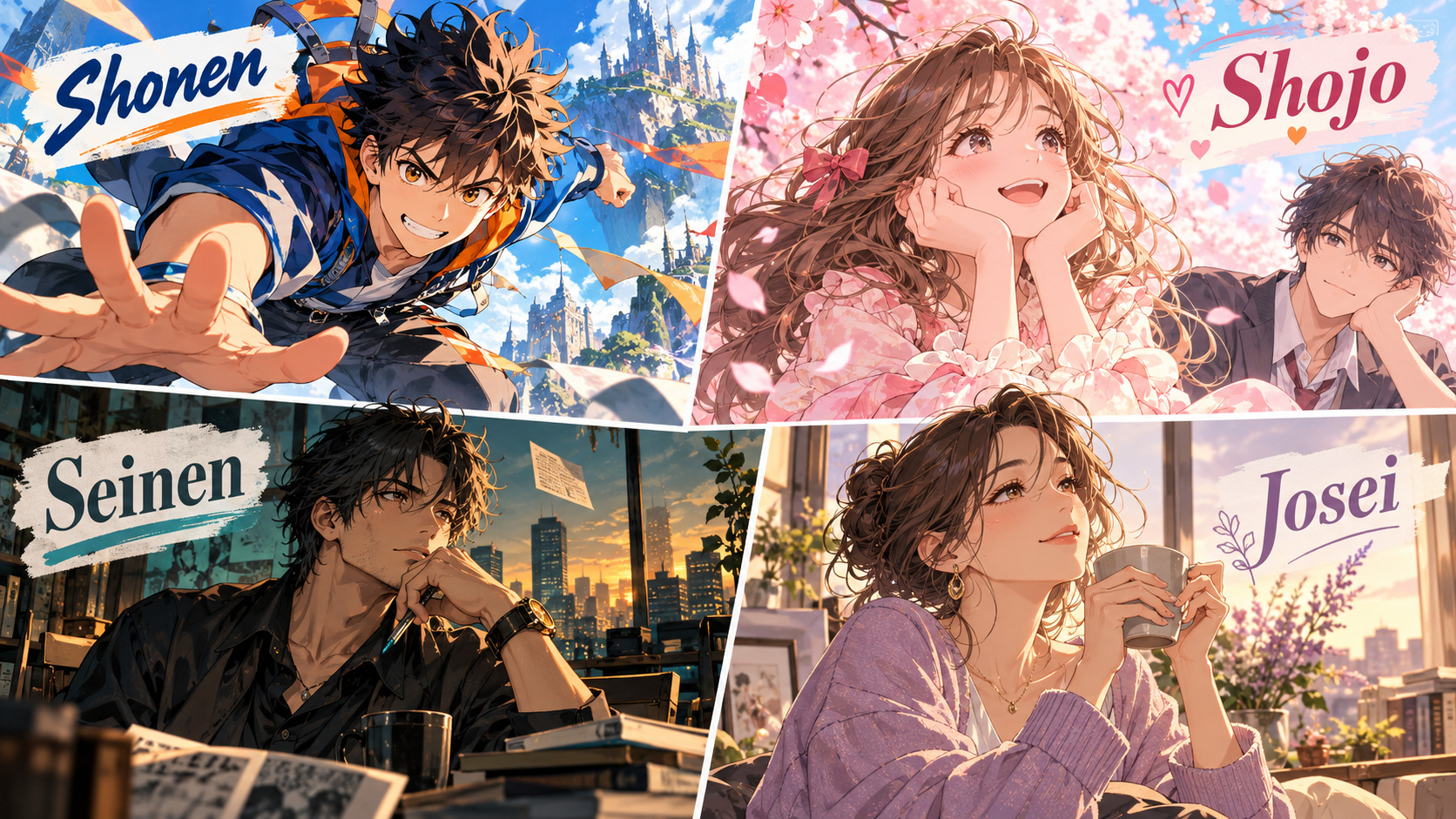
Shonen, shojo, seinen and josei are labels you will encounter while looking for manga and discussing the anime adapted from it. They tell you something about the audience a publication was aimed at. They do not tell you everything about its story, and they do not decide whether you are allowed to enjoy it.
The useful distinction is between intended readership and genre. “Teenage readers” describes an audience. “Mystery” describes a kind of story. Those answer different questions.
The four labels at a glance
| Label | Broad publishing audience traditionally associated with it |
|---|---|
| Shonen | Boys, especially younger and teenage readers |
| Shojo | Girls, especially younger and teenage readers |
| Seinen | Young adult and adult men |
| Josei | Young adult and adult women |
Ohio State University Libraries distinguishes manga demographics from story genres. These are broad audience categories, not universal age cutoffs. Actual readers can be much more varied than a traditional label suggests.
You may also see spellings such as shounen, shoujo, shōnen and shōjo. These are alternative ways of writing the same Japanese terms in the Latin alphabet, rather than extra categories to learn.
Shonen does not mean every story is a battle
Shonen is often associated with action, adventure and teamwork. That association can be useful when browsing, but it is too narrow to serve as a definition.
For a concrete example, VIZ introduces Haikyu!! under Shonen Jump and Sports. Its starting point is a boy trying to succeed at volleyball, including the difficulty of working with a former rival. Calling it shonen and calling it a sports story describe different aspects of the same work.
When someone recommends “a good shonen,” ask what they liked: the team dynamic, the competition, the jokes or the action? The answer gives you a much better starting point than the label alone.
Shojo does not mean romance is the only subject
Shojo identifies a traditional readership, not a requirement that every plot revolve around finding a partner. Scholastic's manga reading guide includes mystery, sports, fantasy, comedy, science fiction and horror within shojo, alongside romance and everyday stories.
That makes “I don't like romance, so I don't like shojo” a shortcut worth questioning. It can close off a story you would enjoy before you know its premise.
Try describing the actual experience you want instead: a tense investigation, a magical adventure, an intimate relationship drama or a funny school story. Then look for a title that offers it. You can be selective about a story's interests without rejecting an entire audience category.
Seinen and josei add adult readership context
Seinen and josei are broadly associated with older audiences, traditionally men and women respectively. That context does not tell you whether an individual work is funny, frightening, romantic or contemplative.
Publisher terminology can also be more inclusive than the shorthand table suggests. Scholastic's glossary describes seinen today as aimed at older teen and adult readers of all genders, and josei at older teen and adult readers, mostly women. Treat the table as an introduction to familiar publishing labels, not a precise census of who reads each book.
“Adult audience” is not a promise of intellectual depth or an instruction to expect explicit material. If you want a thoughtful story, look at the questions it explores. If you want to avoid disturbing content, check the individual work's rating and content information. A demographic label cannot do either job reliably on its own.
A label is not a rating, a quality score or a character description
Imagine two invented stories. One follows a student detective through a difficult case. The other follows an adult baker rebuilding a struggling shop. Either premise could be developed with very different levels of violence, humour, complexity or romance. The protagonist's age and gender alone would not settle the intended readership.
Likewise, an expressive drawing style does not tell you whether a work will be gentle. A restrained cover does not establish that it is serious. Those are things to investigate through the actual book, a legitimate sample and useful content information.
Keep three questions separate when choosing:
- Audience context: whom was this work marketed or published for?
- Story appeal: what happens, and what kind of experience does it offer?
- Suitability: is its content comfortable for this reader or viewer?
You might find the first interesting and make your decision mainly from the other two. That is a perfectly useful way to browse.
Why these manga terms appear in anime conversations
Many anime adapt manga, so discussion of an adaptation can carry over the source work's audience label. VIZ's introduction explains that anime often draws on manga. The publishing context can help explain a recommendation, but it is not a complete description of the animated version.
When you see a label attached to an anime, ask what it refers to: its manga source, a publisher's category or a fan's shorthand description. Do not force every original anime or adaptation from another medium into a manga readership box just because the terms are familiar.
For a specific title, start with the publisher's description and publication context rather than guessing from the main character or a single image. If the category is unclear, you can still describe the premise and genre without inventing certainty.
Use the labels to explore, then follow your interests
If a recommendation sounds promising, read its description even when the audience label is unfamiliar. VIZ explicitly notes that shonen and shojo can appeal across age and gender.
A practical search might be “a short fantasy with a female lead” or “a comedy about adults at work.” Those details express what you want to spend time with. Shonen, shojo, seinen and josei can add context as you explore, while the individual story gives you the reasons to stay.