

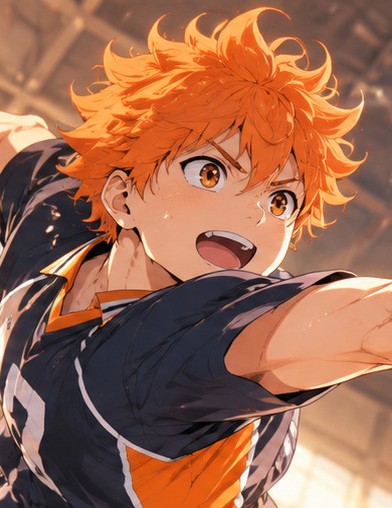
Shoyo Hinata is a volleyball player whose ambition begins with someone else's example. Seeing the player known as the Little Giant compete inspires him to pursue the sport despite his own small stature. His jumping ability offers a way to challenge expectations about height. VIZ series introduction
This profile focuses on the opening of Haikyu!! season one. Hinata is introduced through a clear desire to play, a physical disadvantage and an awkward relationship with the person he wants to surpass.
Ambition before opportunity
Hinata's enthusiasm does not arrive with a ready-made team. The first episode's licensed description introduces him struggling to assemble players for a middle-school tournament. Season-one episode 1 description
That starting situation gives his determination something specific to push against. Wanting to play and having the opportunity to play are separate problems. Our reading is that the effort to gather a team makes his ambition more tangible than a declaration that he loves volleyball would on its own.
What his jump can—and cannot—answer
Hinata's leap is central to the series' introduction of him. It supplies a visible strength alongside his height disadvantage. VIZ introduction
Yet a volleyball team needs more than one person's best attribute. The interesting question in this setup is how that strength might become useful alongside other players. We read Hinata's introduction as an invitation to follow the work between wanting a place on court and contributing to a shared game.
This also keeps his enthusiasm from becoming a claim that effort guarantees every result. A strong desire gives a character direction; it does not settle the competition in advance.
Kageyama: rival and prospective teammate
An early defeat against Tobio Kageyama gives Hinata a personal rival. When they meet again at Karasuno High School, that rivalry becomes a problem for the same club: captain Sawamura insists on team spirit before allowing them to participate. VIZ opening setup, season-one episode 2 description
For us, this is the most useful relationship to understand at the start. Hinata wants to beat someone he may need to cooperate with. His personal goal and the team's needs occupy the same space, giving his competitive energy a complication that jumping alone cannot resolve.
Why follow him?
Hinata makes the appeal of a sports protagonist easy to grasp without requiring detailed volleyball knowledge. Inspiration becomes a goal, the goal meets resistance, and another person complicates the route forward.
His opening story offers a promising combination: the excitement of an individual trying to prove himself and the demands of a game that requires others. How those demands shape him is something to discover by watching, rather than something this introduction needs to give away.