
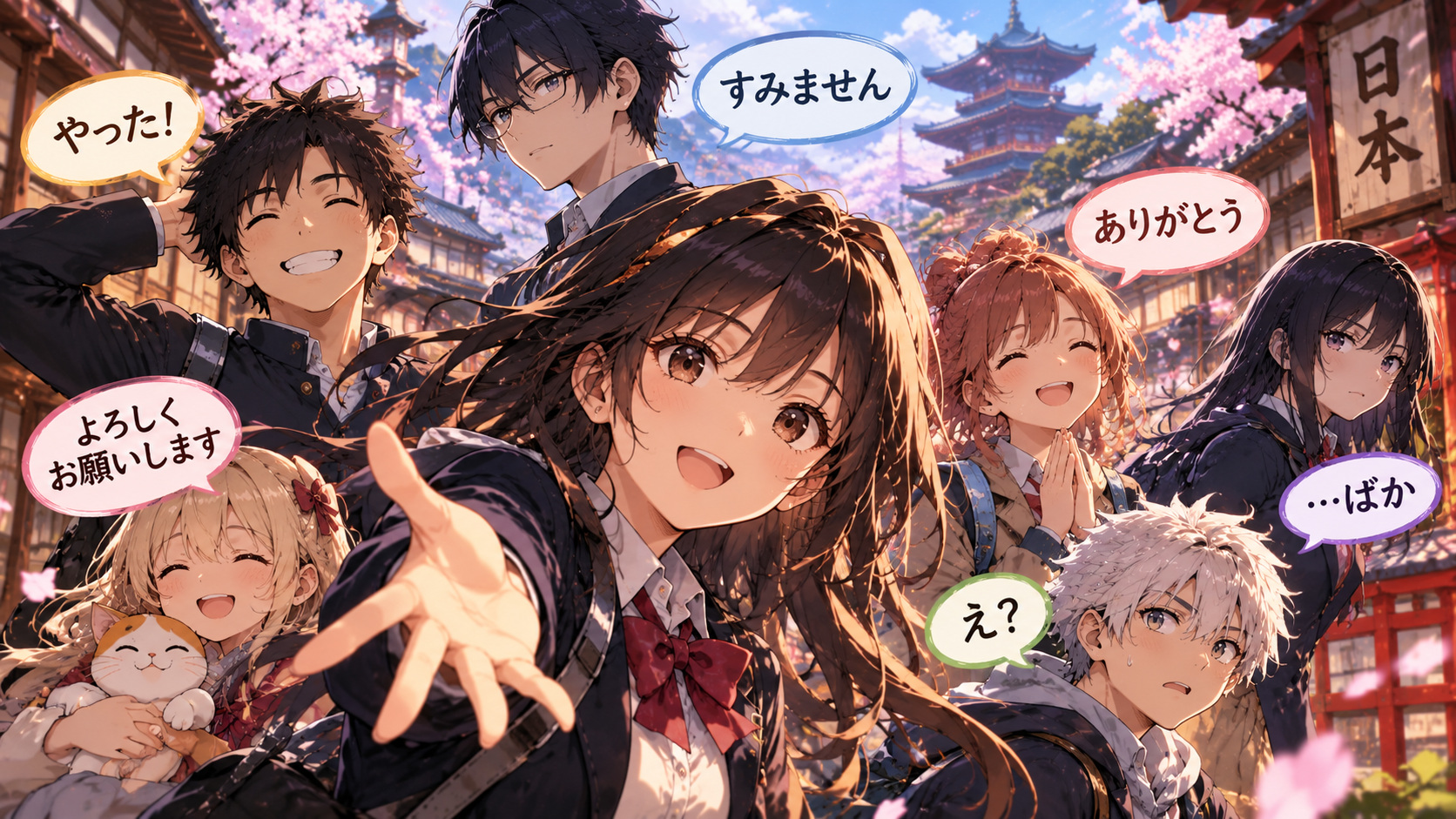
Recognising a few Japanese expressions can make an anime conversation easier to follow. You may begin to notice who is greeting a teacher, apologising to a friend or asking someone to repeat a sentence—even before reading the subtitle.
The important part is context. A familiar sound does not always have one fixed English equivalent, and a line that suits a dramatic scene is not automatically the right way to speak in everyday life.
Here are ten useful words and expressions to start noticing. This is a recognition guide, not a claim about measured frequency across every anime or a complete Japanese lesson.
Greetings, thanks and apologies
The Japan National Tourism Organization's introductory language guide provides the basic meanings of these everyday expressions. The glosses below are starting points, rather than scripts for every social situation.
| Japanese | Romanisation | Useful starting meaning |
|---|---|---|
| おはようございます | Ohayō gozaimasu | Good morning |
| こんにちは | Konnichiwa | Hello / good afternoon |
| こんばんは | Konbanwa | Good evening |
| おやすみなさい | Oyasumi nasai | Good night |
| ありがとう | Arigatō | Thank you |
| すみません | Sumimasen | Excuse me / sorry |
| ごめんなさい | Gomen nasai | I'm sorry |
| わかりません | Wakarimasen | I don't understand |
You may see alternative Latin spellings, such as arigatou instead of arigatō. The table uses one consistent style; recognising the Japanese text and listening to the spoken expression are more useful than treating an unfamiliar spelling as a different word.
Notice what happens around a greeting
An invented scene might begin with someone entering a classroom and saying ohayō gozaimasu. Another might end with a family member saying oyasumi nasai before going to bed. The expressions help mark the social moment, not just translate the time on a clock.
When you hear a familiar greeting, pay attention to the reply and the way it is delivered. Is someone cheerful, distracted or reluctant to acknowledge the other person? Those are performance and story details; the basic vocabulary alone cannot tell you the emotion.
You do not need to interrupt every episode to investigate. One expression noticed in a clear scene can be more memorable than a long list skimmed without context.
Sumimasen and gomen nasai overlap without being identical
Sumimasen can introduce a request or an apology, while gomen nasai is a direct apologetic expression. The Japan Foundation's Irodori lesson 2 uses sumimasen when someone does not understand and asks for speech to be repeated or slowed down.
That is a useful reminder to listen for what the speaker is doing. Are they getting someone's attention, acknowledging a mistake or preparing to ask for help? Translating every sumimasen as the same English sentence would miss those differences.
The lesson also pairs wakarimasen with requests for clarification. Recognising it can help you follow a scene where a character is confused, without assuming that confusion is necessarily rude or confrontational.
Thanks can appear as part of a longer expression
You may hear arigatō on its own or the longer arigatō gozaimasu. Irodori's beginner conversation examples show the longer form when a speaker thanks someone for assistance.
Notice the relationship and situation around it rather than deciding that the extra words are decorative. A character may speak differently to a close friend, a customer or someone they have just met. To learn which form to use yourself, follow a structured language lesson that explains politeness as well as vocabulary.
Sensei: a title that depends on the role
先生 — sensei is familiar as a way to address a teacher, but its use extends beyond the classroom. Tofugu's guide explains other professional contexts, including doctors.
If a character calls someone sensei, use the scene to work out the relevant role. The word does not automatically mean “the strongest person” or “the oldest person present.” A school scene and a clinic scene can use the same title for different kinds of expertise.
For anime discussion, that is often enough to make a relationship clearer. It is not a universal instruction to call anyone whose skills you admire sensei.
Senpai: seniority, not automatically romance
先輩 — senpai refers to a senior within a relevant shared setting, such as a school, club or workplace. Tofugu's explanation distinguishes that everyday relationship from romantic internet associations.
An invented club scene might have a newer member address an established member as senpai while asking about a routine. Nothing in the word alone proves that the newer member has a crush, or that the senior is their teacher.
Ask what the people share and how seniority works in that situation. That is more informative than translating the title as a romantic role whenever it appears.
Use the subtitle and the scene together
A subtitle translates a line in context, not a separate dictionary entry for every sound. If an expression you recognise receives different English wording, look at the complete exchange before assuming a mistake.
Try a small exercise during a legal viewing session: notice one expression, identify whom the speaker is addressing and consider what the line accomplishes. Then continue watching. You can investigate it afterward with a reliable learning resource if it interests you.
Recognising words is a satisfying beginning. Understanding the relationships, tone and situation around them is what makes that recognition useful.